Quick answer (updated November 2026): Some construction companies in Lahore subcontract the whole house: they take your contract and pass it to labour contractors who bid the lowest rate per square foot. The company then collects payment but no longer builds, so nobody is accountable for quality. Before you sign, confirm that the company runs your site with its own supervisors, engineers, MEP team and equipment. If it cannot show them, your quote is a resale.
By Waqas Rana, Owner, Glorious Builders. Updated 10 November 2026. Based on my video on how construction companies in Pakistan really work.
Key points
- Reselling a project to labour contractors is a business model, not a rare accident. Clients almost never ask about it.
- In a resold project, the company has no workers on site and the contractor has no standard to follow. The client carries the quality risk.
- An in-house team means the company’s own managers, engineers, supervisors, MEP crew, machinery, storage and transport.
- You can verify this before signing with eight simple checks, listed below.
- In-house work costs the company more to run, so a very low quote needs an explanation.
The question clients rarely ask a construction company
This article is about construction company subcontracting: a company that signs your contract and then hands the work on. It is not about hiring a labour supplier yourself (read labour supplier vs professional construction company for that), and it is not a general guide to choosing a builder (see how to compare construction companies in Lahore).
The most important question in house construction is rarely asked: who will physically build my house? Most clients compare rates, designs and finishing samples. They do not ask whether the company they are paying will actually do the work.
A question from a client in Jeddah led me to make a video on this topic. I am Waqas Rana, the owner of Glorious Builders. In this article I explain how the resale model works, why it damages quality, and how you can check any company, including ours, before you give an advance.
One thing first. Quality assurance only works if you have done your homework as a client. A company cannot assure quality it does not control, so the first job is to find out how much control it has.
How a resold construction project works
A resold project is one where the company that signs your contract hands the actual building to an outside labour-supply contractor and keeps a margin. The company stays visible to you, but the work is done by someone you never met.
Here is the pattern I describe to clients, using simple example numbers. Three labour contractors are invited to the office to quote on a project. The first asks Rs 500 per sq ft for labour, the second Rs 600 and the third Rs 700. These figures are an illustration, not a market quote.
The company prefers the Rs 500 contractor and says: “Leave Rs 25 or 30 per sq ft for us, and we will give you more projects.” The contractor agrees to roughly Rs 475 because he wants the next job. The company then takes your contract at its full price and passes the labour work down at that lower rate.
The arithmetic is simple. On a 2,000 sq ft covered area, a Rs 25 cut per sq ft is Rs 50,000 on that one project, earned without hiring a single worker. Multiply it by every project the company sells on, and the incentive to resell is clear.
Now count who is on your site. The company is not there, because it only manages paperwork and payments. The contractor is there, but he has already been squeezed on price, so every decision on your house is a decision about his own survival.
Why the client is the one who loses
The client loses because accountability disappears between the two parties. The company says the contractor did the work. The contractor says he followed the rate he was given. Neither owns the result, and you hold the loss.
This is the part that makes the model dangerous. The contractor has his own costs to cover: petrol, daily expenses, his own income. He has no reason to follow standards that nobody checks, and he often does not even listen to the company that gave him the project. So when you complain to the company, the company has no authority on the site.
Research on the sector points the same way. A 2012 study of subcontracting in Pakistan’s construction industry, published in the Journal of Construction Engineering and Management, found that subcontracting and sub-subcontracting are widespread, and that the substandard quality of subcontractors’ work was the main problem area (ASCE abstract). The same study reports that about 53% of respondents were satisfied with their subcontracting experience and 47% wanted changes. It also recommends fewer subcontracting tiers and proper evaluation of subcontractors.
What it looks like two years later
A house built with responsibility should not show serious problems even after decades. A house built through a resale chain often develops them within one and a half to two years: cracks, seepage, uneven finishes, services that fail. When that happens, the client discovers that the company never built the house, so it has no crew to send back.
That is why I say the problems of a house are usually decided on day one, when the company chooses either to build the project or to sell it on.
In-house team versus resold project: the difference in practice
The difference between an in-house project and a resold one is who stands on your site every day and who answers when something goes wrong. The table below sets out what changes for you as a client.
| Question you should ask | In-house construction team | Resold to labour contractors |
|---|---|---|
| Who sets the quality standard? | The company’s own engineers and supervisors | Each contractor uses his own standard, if any |
| Who is on site every day? | Company supervisors and a construction manager | The contractor’s foreman, often several projects at once |
| Who does plumbing and electrical work? | The company’s own MEP team, plumbers and electricians | Separate people hired per job at the lowest rate |
| Who fixes a defect after handover? | The same company crew, under the written guarantee | The company points to the contractor, who may not answer the phone |
| What does the company’s quote cover? | Materials, labour and supervision it controls | A margin on top of the contractor’s cut rate |
| Who carries the risk? | The builder | The client |
What an in-house construction team actually means
An in-house construction team is a group of managers, engineers, supervisors and trades that the company itself employs, with its own machinery and yard, so it can run a project from the first day to the last. A phone list of contractors does not count.
When a company tells you it has an in-house team, it should be able to show these ten things:
Each item answers a specific risk. Supervisors and a construction manager control daily quality. Structural engineers and structural supervisors control the part of the house that cannot be corrected later: foundations, columns, beams and slabs. An MEP team, meaning mechanical, electrical and plumbing, keeps pipes and wiring consistent with the plan. Machinery, storage and transport show that the company has a base of its own and is not renting everything per job.
Why storage, vehicles and a yard matter
A company that owns a yard, vehicles and equipment has fixed costs, a reputation tied to a place, and a reason to stay in business. A company that is only a phone number and a sales office can disappear after the advance. When I look at a competitor I do not ask about their brochure. I ask where their materials are stored.
Plot to furniture: why one accountable company matters
My advice to anyone building is to choose a company that can serve you from the purchase of the plot to the completion of the house, and even the furniture. The more of the job one accountable company controls, the fewer gaps there are for blame to fall into.
A turnkey project, where one company manages design, structure, finishing and handover, tends to suit the client because responsibility sits in one place. It is not the only good model, since other factors matter too, but it removes the hand-offs where resale happens. If you want to understand where a grey structure ends and finishing starts, read our guide to grey structure construction, and the difference explained in builder vs construction company.
Eight checks before you sign with any construction company
You can test whether a company builds or resells before you pay a rupee of advance. These eight checks take a few days and cost nothing but your time.
- Ask who supervises your site every day. Get a name, a role and a confirmation that this person is on the company’s payroll, not the contractor’s.
- Ask whether the workers on your site are employed by the company. If the answer is “our labour partner”, you are being told about a resale.
- Visit the office and the storage yard. A real builder will show you materials, tools and equipment without notice.
- Meet the structural engineer and the structural supervisor. Ask who signs off on foundations, columns and slabs.
- Ask about the MEP team. Plumbers and electricians should be named, not “arranged later”.
- Visit a running project. Talk to the supervisor on site and see how work is organised on an ordinary working day, not a prepared showroom.
- Ask for a written clause. The contract should say that structural work will not be passed to another contractor without your written consent.
- Ask what happens after handover. A guarantee is only as strong as the crew behind it. Our structural guarantee is 15 years, and the written contract states what it covers.
Take the same checks to every company on your shortlist. If you are comparing several, our page on construction companies in Lahore explains how to line them up fairly, and a written BOQ for house construction shows exactly what each rate includes.
Red flags that point to a resold project
A resold project leaves signs long before the first brick is laid. These are the ones I see most often.
- The quote is much lower than every other company, and nobody can explain how.
- The company has no yard, no storage and no machinery of its own.
- Questions about the site supervisor get vague answers such as “our team will handle it”.
- The person who negotiates your contract disappears once the advance is paid.
- You are asked to deal directly with a contractor on site for changes and payments.
- Different crews appear every few weeks with no continuity.
- The company will not let you visit a running site.
Where a resale chain damages a house, stage by stage
A resale chain does the most harm at the stages that cannot be inspected once they are covered. Each stage below needs a trained eye on site, and each is where an unsupervised, underpaid crew saves time at your expense.
| Stage | What needs daily supervision | What goes wrong without it |
|---|---|---|
| Excavation and foundation | Depth, soil compaction, footing size, steel placement | Footings dug shallow or reinforcement laid wrongly, hidden once concrete is poured |
| Columns, beams and slab | Bar spacing and cover, concrete mix, curing days | Thin cover, rushed pours and dry curing weaken the structure |
| Brickwork | Brick quality, mortar mix, line and level | Crooked walls, weak joints and later plaster cracks |
| Plumbing and electrical rough-in | Pipe routes, pressure tests, conduit depth | Leaks and rewiring after tiles and paint are done |
| Plaster, waterproofing and finishing | Surface prep, membrane laps, drying time | Seepage, hollow plaster and peeling paint within two years |
None of these failures is exotic. They are the normal result of work that nobody with authority is watching. The structural stages matter most because they are the hardest and most expensive to correct later, which is why I treat foundations, columns, beams and slabs as the first place to ask who is responsible.
What to look for on a site visit
When you visit a running site, look beyond the finished wall. Check whether the supervisor knows the plan without looking it up, whether materials are stored under cover and in order, whether the crew wears the same company identification from week to week, and whether the drawings are on site. Ask the supervisor one detailed question, such as the slab thickness or the bar spacing on a beam. A person who runs the site answers at once. A person who was hired this week does not.
The trade-off: in-house work costs the company more
An in-house team costs more to run than a list of contractors, and that is part of why some companies avoid it. A company with its own staff pays salaries in slow months, maintains equipment and carries responsibility for every defect. The 2012 Pakistan study I cited reports that using direct labour was found unprofitable because of uncertain workloads and higher administrative overhead.
That is a real business pressure, and I will not pretend otherwise. It is also why you should be suspicious of a quote that looks too good: somebody in the chain has to absorb the cost, and it is usually the quality of your house.
When subcontracting is acceptable
Subcontracting is not always wrong. Specialist trades such as lifts, glass facades or specialised waterproofing may be done by a specialist firm. The condition is that the main company supervises the work, names the firm in the contract, and stays accountable for the result. The danger is not that someone outside the company works on your house. The danger is that nobody inside the company is watching.
Why price alone is the wrong comparison
Comparing two quotes only by rate per square foot hides the one number that matters: what that rate pays for. A quote that includes engineers, supervisors and a crew who are paid regularly and answer to the company is a different product from a quote that includes a margin and a contractor.
The right comparison is the written BOQ. Ask each company to show its scope line by line, name who executes each part, and state what happens if work fails inspection. If a company will not discuss who does the work, you are not comparing like with like. You are comparing a builder with a broker.
What our sites look like
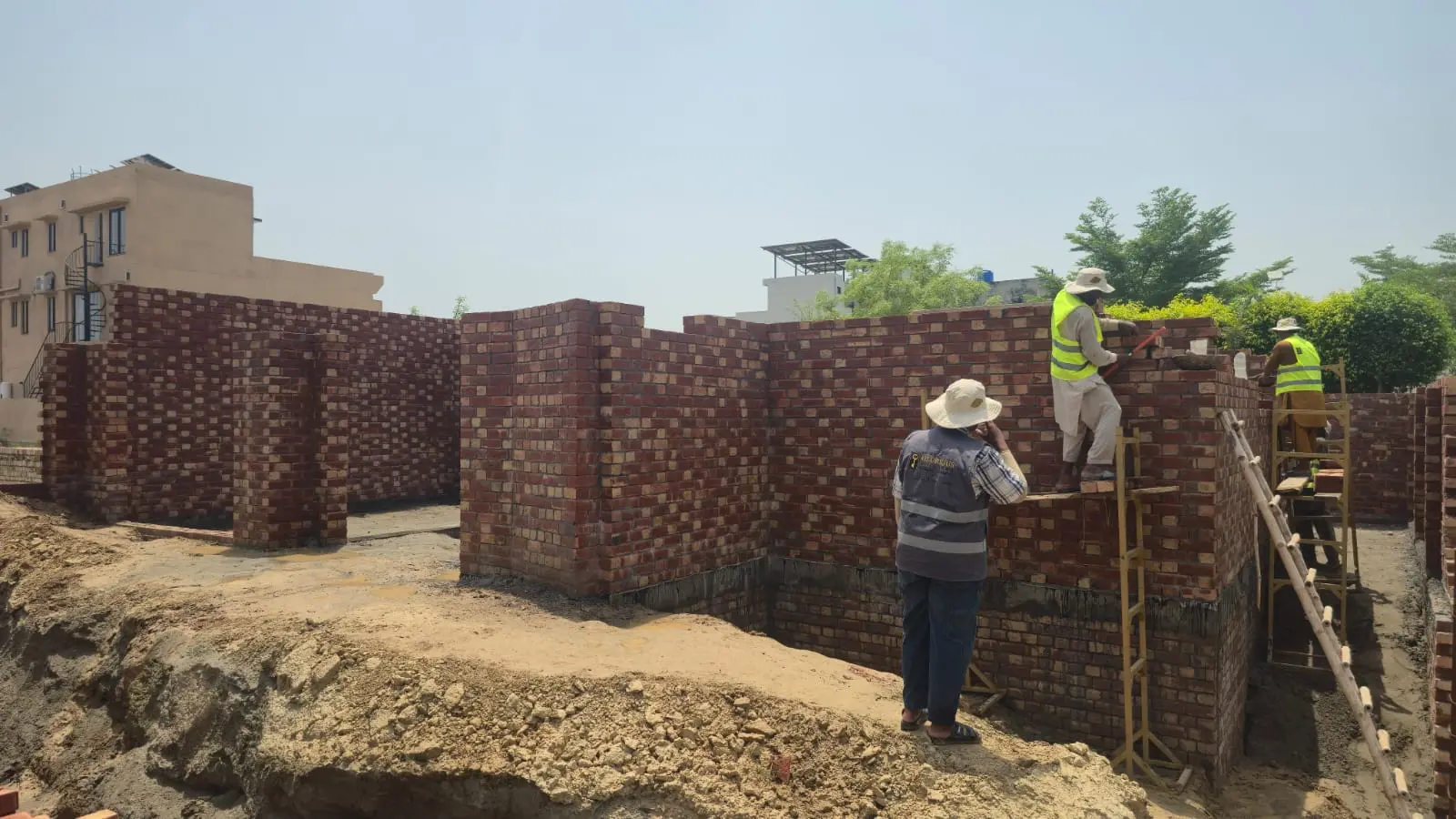
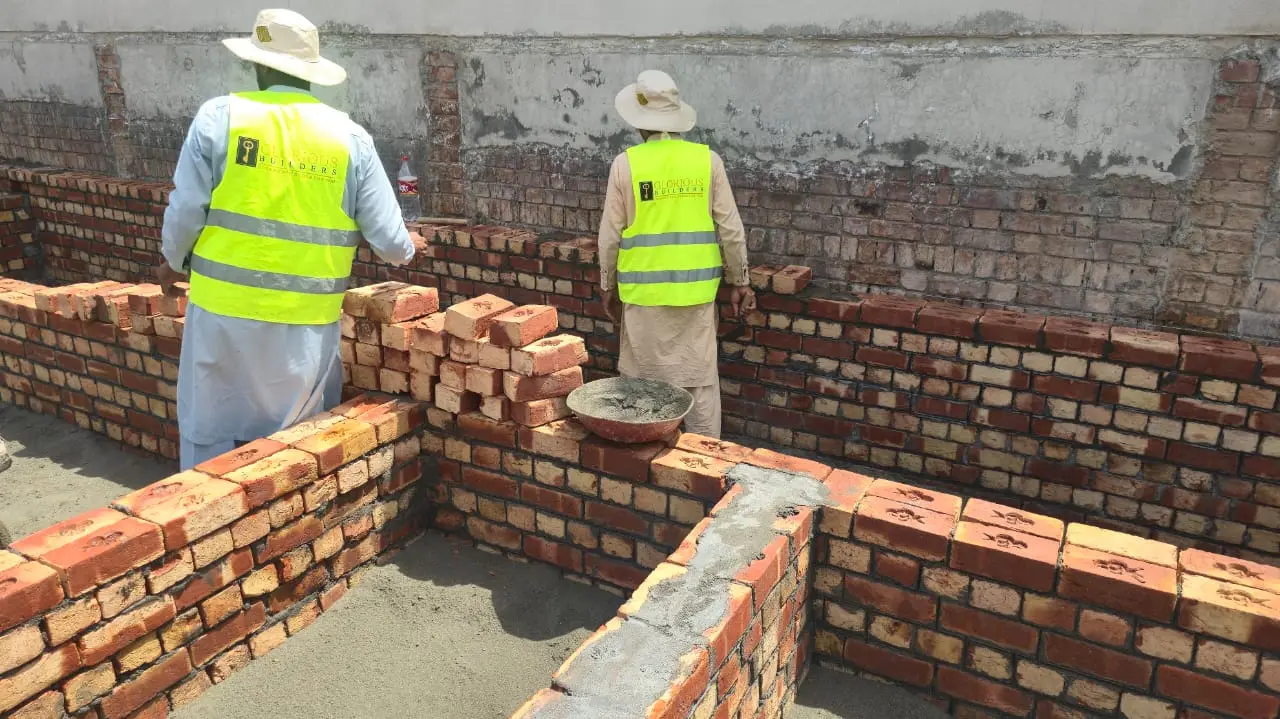
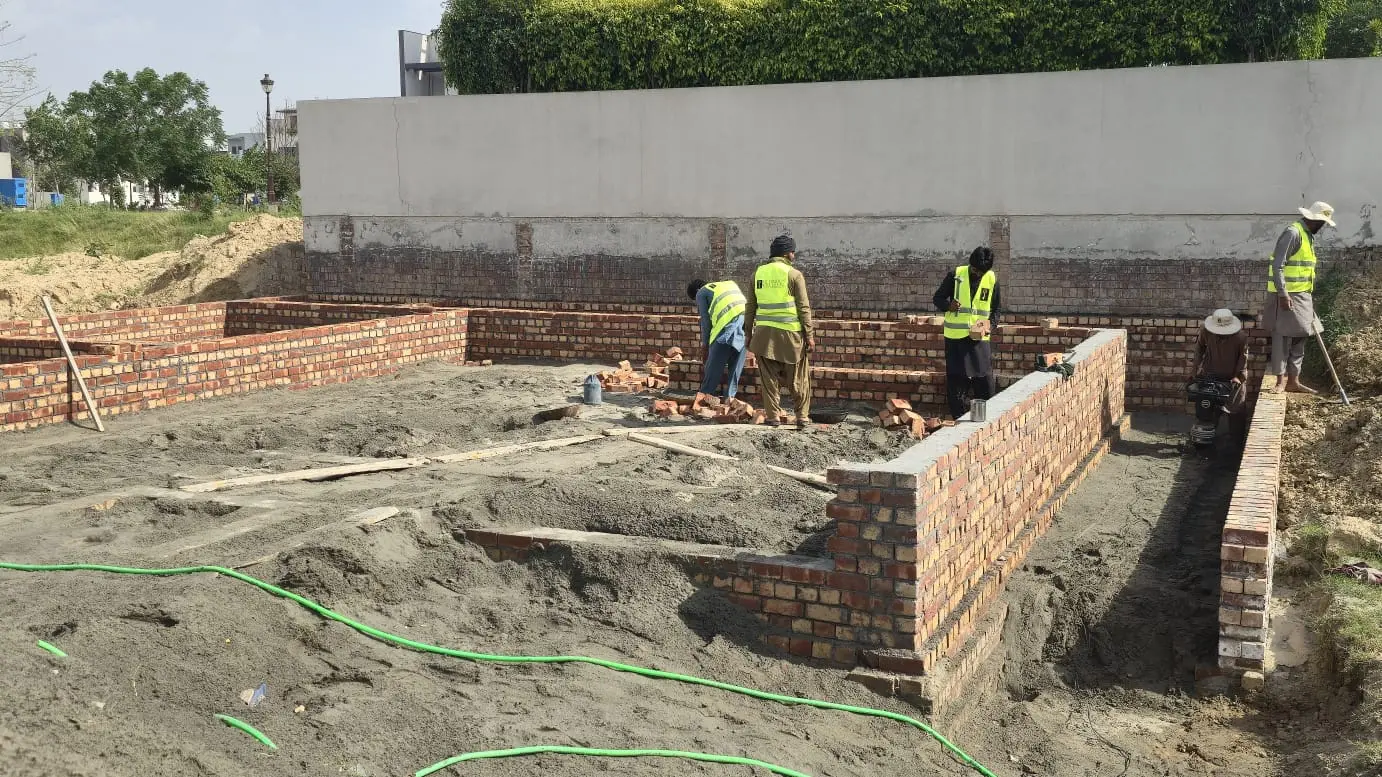
These photos come from Glorious Builders sites in Lahore.
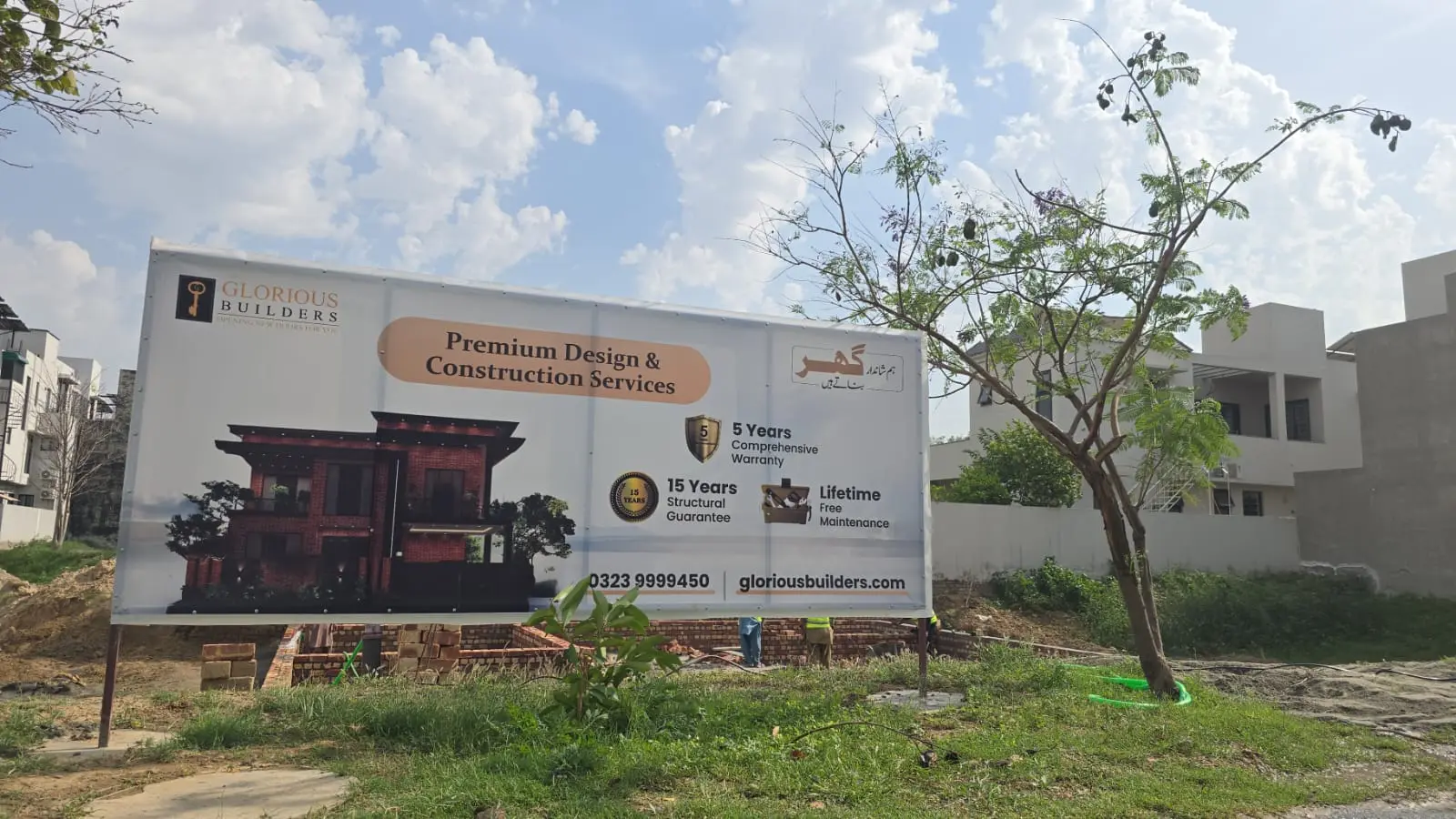
Dated project logs you can check
Our site keeps dated stage logs for running projects, so you can compare what a company shows with what it says. Examples include a 1 Kanal house in DHA Phase 7, foundations to lintel (April to August 2026), a 10 Marla house in Lake City, grey structure (August to September 2026), and brick masonry by our team at DHA Lahore sites. These logs show stages and photos. They do not replace the checks above, and you should still ask to meet the supervisor on a running site. See also our society pages for DHA Lahore and Lake City.
Why this matters even more for overseas Pakistanis
If you live in Jeddah, Dubai, London or Toronto, you cannot walk onto the site to see who is working. You depend completely on the company’s own people. For an overseas client, an in-house team is the difference between a house that is supervised daily and a house that is only reported on.
Ask the checks above by video call, ask for the supervisor’s name, and insist on a written contract before you transfer money. Our guides on building a house in Pakistan from abroad and the overseas Pakistani construction process walk through the steps.
How Glorious Builders works
At Glorious Builders we run our projects with our own construction managers, supervisors, structural engineers and structural supervisors. We have an MEP team with our own plumbers and electrical crew, along with machinery, storage space and transport. I give this as my own statement as the owner, and you are welcome to verify every item on the list above at our office and on a running site.
- Written contract: every project is priced on a written BOQ contract, so you know what each rate covers.
- Grey structure estimate: approximately Rs 3,000 to Rs 3,250 per sq ft, with the final figure set in your BOQ.
- Guarantees: a 15-year structural guarantee and a 5-year finishing warranty.
- Reputation: rated 4.8 from 262 Google reviews.
- Experience: more than 500 projects delivered across Lahore and Punjab.
A company that tells you it will not resell your project should be willing to put that in writing. We are.
Frequently asked questions
What is an in-house construction team?
An in-house construction team is the group of managers, engineers, supervisors, plumbers, electricians and labour that a construction company employs directly, together with its own machinery and storage. It is different from a company that contracts each trade to outside parties after signing your agreement.
Do construction companies in Lahore really subcontract houses to labour contractors?
Yes, some do. A 2012 study of subcontracting in Pakistan’s construction industry found that subcontracting and sub-subcontracting are widespread and that poor quality of subcontractors’ work was the main problem. Not every company does this, which is why you should check before signing.
How do I know if my construction company is subcontracting my house?
Ask who supervises your site every day and who employs the workers. Visit the company’s yard and a running site, and look for a named supervisor, a visible MEP team and company equipment. If answers are vague or depend on a “labour partner”, the project is probably resold.
Is subcontracting always bad for my house?
No. Specialist work such as lifts, glass or advanced waterproofing can be done by a specialist firm. It becomes a problem when the main company does not supervise the work or stays unaccountable for it. The contract should name any subcontractor and state who is responsible.
Why are some construction quotes so much lower than others?
A low quote usually means someone in the chain has been squeezed on price, often the labour contractor, whose rate is cut again before work starts. That pressure shows up as lower supervision and weaker quality. Ask for a written BOQ that shows what the rate covers.
Can I include a no-subcontracting clause in my contract?
Yes. A reasonable clause states that structural work will not be passed to another contractor without your written consent. A company that is confident in its own team should accept it without argument.
Should overseas Pakistanis choose a turnkey company?
A company that manages design, structure, finishing and handover gives you one accountable party, which is useful when you cannot visit the site. It still needs to pass the same eight checks: named supervisors, own crew, a running site you can see, and a written contract.
Read next: Labour supplier vs professional construction company · Builder vs construction company · Construction companies in Lahore · Glorious Builders
Planning your own house? Cost guides from Glorious Builders:
Written by Hafiz Furqan Ahmad. Reviewed by Waqas Rana, Owner, Glorious Builders.